

How Greenville, SC Has Changed Since 2000 🏙️
How Greenville SC changed since 2000 is not just a story about Falls Park, downtown restaurants, or the Liberty Bridge.
Yes, those things matter. In fact, downtown Greenville became the image many people now recognize first. But the bigger story is about jobs, healthcare, schools, roads, housing, airport access, and the way Greenville County changed direction over the last 25 years.
Greenville did not simply get bigger. It became more connected, more visible, more competitive, and more complicated.
I’m Chris Horrell, your native-born Greenville Realtor, and I’ve had more than 40 years to watch this area grow, shift, stretch, and reinvent itself. My team and I help people understand the different lifestyles, neighborhoods, communities, and commute patterns across Greenville County, so they can find the right fit, not just the right house.
What Made Greenville SC Change So Much Since 2000? 🌱
Greenville SC changed so much since 2000 because several major forces hit at the same time: downtown revitalization, job growth, healthcare expansion, education investment, housing demand, and infrastructure pressure.
That is why it is too simple to say Greenville became popular because of Falls Park.
Falls Park helped. Main Street helped. Liberty Bridge definitely helped. However, those were the symbols. The deeper engine was the economy, the employers, the schools, the hospitals, the airport, and the neighborhoods that followed.
According to the U.S. Census Bureau, Greenville County had 451,225 people in 2010, 525,534 people in 2020, and an estimated 583,125 people in 2025. That is a major shift in a relatively short window, especially for anyone who remembers when parts of the county still felt quiet, rural, or overlooked.
Key takeaway: Greenville did not wake up one day and become popular. The bones were already here, but the county finally started connecting the pieces.
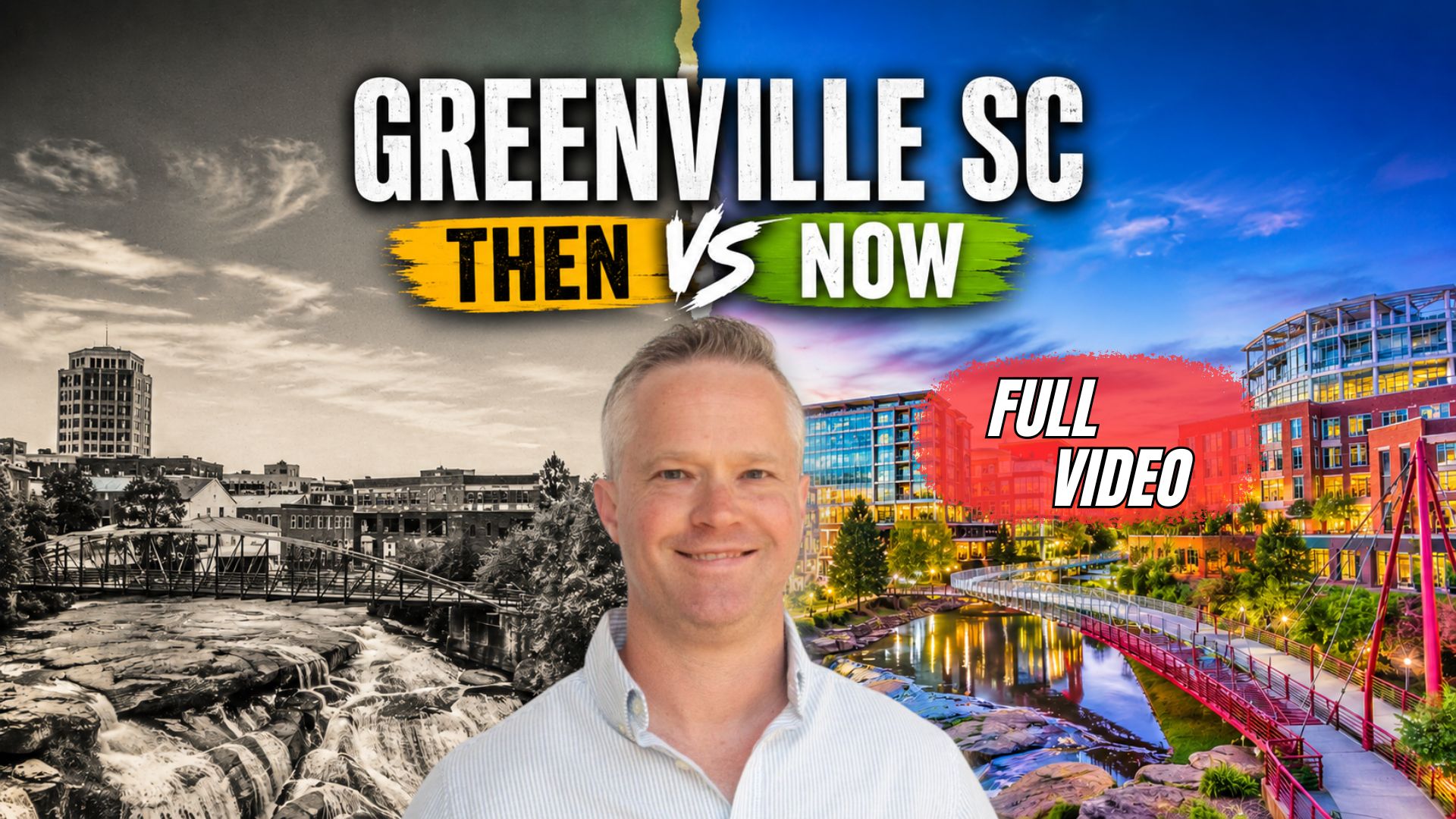
How Did Downtown Greenville Become the Symbol of the City? 🌉
Downtown Greenville became the symbol of the city because it gave people a visible before-and-after story.
In 2000, Main Street already had charm, history, and potential. However, Greenville had not yet reached the level of lifestyle appeal that people talk about today. The Reedy River was there, but people did not experience it the way they do now.
Then Greenville made a decision that changed its image.
The city restored access to the river, removed the old bridge that blocked the falls, and helped turn the area into a true gathering place. Transportation for America notes that the Camperdown Bridge came down in 2002 and the Liberty Bridge opened in 2004, helping shift the area from vehicle traffic to foot traffic.
That mattered because people do not fall in love with a city because it has buildings. They fall in love with the experiences those places create.
Dinner downtown.
A walk across Liberty Bridge.
Saturday morning market.
A night at Fluor Field.
A stroll through the West End.
That is where Greenville figured something out.
A city becomes loved when people build their life around it.
Why Was Falls Park Such a Turning Point for Greenville SC? 💦
Falls Park was a turning point because it turned a hidden natural feature into Greenville’s most recognizable public space.
Before the transformation, the falls were easy to miss. Today, the Reedy River and Liberty Bridge are among the first places people take visitors. VisitGreenvilleSC describes Falls Park on the Reedy as the heart of downtown and highlights how the Liberty Bridge connects downtown to the West End.
That change did more than improve a view.
It changed the story Greenville told about itself.
For locals, downtown became a source of pride. For visitors, it became a surprise. For people relocating here, it created that “I had no idea Greenville was like this” reaction.
That emotional reaction matters in real estate.
When people can picture their weekends, their walks, their restaurants, and their family visits, a place starts to feel less like a dot on a map and more like a possible life.
What Was the Real Engine Behind Greenville County’s Growth? ⚙️
The real engine behind Greenville County’s growth was not only downtown. It was the combination of jobs, healthcare, education, advanced manufacturing, research, logistics, and regional access.
Downtown gave Greenville the image. The economy gave people a reason to stay.
According to Greenville Area Development Corporation, major employers in Greenville County include Prisma Health, Greenville County Schools, Michelin North America, Bon Secours St. Francis Health System, Duke Energy, Greenville County Government, and the State of South Carolina. These employers span healthcare, public education, manufacturing, utilities, government, and technology-related sectors.
That mix matters.
A pretty downtown can attract attention. However, people build a life around work, schools, healthcare, and opportunity.
So, when people ask why Greenville looks so different today, the answer is not one thing. It is a chain reaction.
Jobs create opportunity.
Opportunity attracts people.
People create housing demand.
Housing creates new retail and roads.
Growth creates pressure.
That is the Greenville story in one simple sequence.
How Did Greenville’s Economy Change After 2000? 🏭
Greenville’s economy changed after 2000 by moving from an older industrial identity into a broader economy built around healthcare, advanced manufacturing, automotive research, education, and business investment.
For generations, Greenville County was shaped by textiles, mills, manufacturing, and industrial work. That history still matters. You can see it in older mill villages, historic buildings, and the county’s work-first identity.
However, the economy did not stay frozen in that older chapter.
One clear example is CU-ICAR, the Clemson University International Center for Automotive Research. CU-ICAR says it was founded in 2007 and is home to automotive engineering programs, more than 20 corporate partners, and research infrastructure focused on the future of mobility.
That is a big clue about Greenville’s direction.
Greenville is not only a place where things are made. It is also a place where things are designed, tested, improved, engineered, and imagined.
That shift matters for buyers and sellers because economic growth changes the housing conversation. People do not just ask, “Is Greenville nice?” They ask, “Can my career grow here? Can my family work here? Can I retire here? Can this place support my life long term?”
Increasingly, the answer for many people has been yes.
How Did Healthcare and Schools Help Greenville Grow? 🏥
Healthcare and schools helped Greenville grow because they made the county more livable for families, retirees, employers, and relocating professionals.
Healthcare is not just a service. In Greenville County, it is also a major economic anchor.
Greenville Area Development Corporation lists Prisma Health with more than 10,000 employees and Bon Secours St. Francis Health System with 2,501 to 5,000 employees. That makes healthcare one of the major forces supporting the county’s economy and long-term livability.
This matters when families compare Greenville to larger metros.
They ask practical questions.
Can my parents move here?
Can my family access specialists?
Can I retire here?
Can I find healthcare jobs?
Can I get care without driving to Charlotte or Atlanta?
Schools are just as important.
Greenville County Schools is also listed as a 10,000-plus employee organization by GADC. Public education, career centers, technical training, and workforce development help connect the next generation to the industries already growing here.
That is one reason Greenville’s growth feels different from ordinary sprawl. The county is not only attracting people. It is also trying to train and support the people who already live here.
How Did Housing Growth Change Greenville County? 🏡
Housing growth changed Greenville County by turning it into a collection of micro-markets, each with a different lifestyle, price point, commute, and community feel.
This may be the part locals feel most.
It is one thing to see downtown change. It is another thing to watch quiet roads become subdivisions, school traffic, grocery stores, turn lanes, and model homes.
In 2000, many buyers thought of Greenville County in simpler terms. They might have focused on a side of town, a school zone, a commute, or an older established neighborhood.
Today, the choices are much more layered.
You have downtown condos.
You have historic homes.
You have infill construction.
You have suburban neighborhoods.
You have master-planned communities.
You have luxury pockets.
You have golf communities.
You have acreage properties.
You have trail-connected areas near the Swamp Rabbit Trail.
You have new construction in places that used to feel like the edge of the county.
The Census Bureau estimates Greenville County had 253,152 housing units in 2025, along with 4,947 building permits that year. Those numbers help explain why so many residents can feel the physical growth around them.
Here is the part buyers need to understand: moving to Greenville is too broad of a search.
The better question is this: Which version of Greenville actually fits your lifestyle?
Why Does “Moving to Greenville” Mean Different Things Today? 📍
“Moving to Greenville” means different things today because Greenville County is not one lifestyle. It is many lifestyles under one county name.
One buyer may picture a downtown condo where they can walk to dinner.
Another buyer may want suburban convenience, school access, and a newer home.
Another may want to live near the Swamp Rabbit Trail.
Another may care most about being near GSP Airport, I-85, or major employers.
Another may want acreage, privacy, and a quieter pace.
Those are completely different searches.
That is why two neighborhoods can be only 15 or 20 minutes apart and feel completely different. The commute changes. The school conversation changes. The home style changes. The weekend routine changes.
And sometimes, that is where buyers get caught off guard.
A listing can show you bedrooms, bathrooms, square footage, and photos. But it cannot fully explain how your daily life will feel.
Will you spend weekends downtown?
Will you want trail access?
Will you need a shorter commute?
Will you want sidewalks and neighborhood amenities?
Will you want privacy and land?
Will you care more about schools, shopping, or airport access?
That is why local guidance matters.
You do not want the right house in the wrong location.
How Has Traffic Changed Greenville SC Since 2000? 🚗
Traffic has changed Greenville SC since 2000 because jobs, housing, retail, and commuting patterns expanded faster than some roads could comfortably handle.
If you want proof of Greenville’s growth, look at the roads.
Woodruff Road is one of the clearest examples. It became a major retail and commercial corridor, but that success also created congestion. SCDOT says the Woodruff Road Congestion Relief Project aims to improve mobility in the busy commercial area between I-385 and Roper Mountain Road or Verdae Boulevard.
SCDOT also notes that the corridor experiences high congestion during peak times, with more than 40,000 vehicles per day in the most congested section.
That is not just a traffic complaint. It is evidence.
Retail followed rooftops.
Rooftops followed jobs.
Jobs followed access.
Then the roads had to catch up.
At the same time, transportation is also one of Greenville’s strengths.
Greenville-Spartanburg International Airport served more than 3 million total passengers in 2025, according to the airport’s statistics. GSP also reports that its economic impact reached $4 billion in 2023.
For relocation buyers, that matters.
Airport access can change how Greenville competes with larger metros. It helps executives, families, sales teams, logistics users, and frequent travelers stay connected without living in Atlanta or Charlotte.
So, yes, traffic is a challenge. But access is also one of Greenville’s advantages.
What Is the Biggest Trade-Off From Greenville’s Growth? ⚖️
The biggest trade-off from Greenville’s growth is that opportunity came with pressure.
Greenville gained more jobs, restaurants, neighborhoods, housing choices, visibility, and energy. However, it also gained more traffic, higher housing demand, infrastructure stress, and affordability concerns.
That is why Greenville’s growth story needs honesty.
You can be proud of what Greenville became and still miss what it used to feel like.
Longtime locals may remember quiet roads, open fields, and places that felt less crowded. New residents may see opportunity, charm, and lifestyle. Both perspectives can be true.
Growth is not free.
Every new neighborhood changes something. Every new road project affects someone. Every new business adds opportunity, but also demand. Every new resident adds energy, but also pressure.
So the question is not whether Greenville will grow.
The real question is whether Greenville can grow wisely.
Can Greenville keep the charm that made people love it?
Can it improve roads without losing character?
Can it add housing without pricing out locals?
Can it stay connected without becoming generic?
That is the next chapter.
How Can Chris Horrell Help You Find the Right Version of Greenville? 🤝
Chris Horrell helps buyers, sellers, and relocating families compare Greenville communities based on lifestyle, commute, housing type, school conversations, and long-term fit.
That matters because Greenville is not one-size-fits-all.
The right fit may be downtown energy.
It may be new construction.
It may be acreage.
It may be trail access.
It may be a quiet established neighborhood.
It may be a short commute to work.
It may be a school zone or a lower-maintenance lifestyle.
As a native-born Greenville Realtor with more than 40 years watching this town grow, Chris brings a perspective that goes beyond the listing. He helps clients understand what different parts of Greenville County actually feel like in real life.
Because the goal is not just to buy a house.
The goal is to find the version of Greenville that fits your life.
Final Thoughts: Greenville Did Not Just Grow, It Changed Direction 🌄
Greenville SC changed since 2000 because the county moved from one era into another.
Downtown became the symbol.
Falls Park revealed the view.
Liberty Bridge gave Greenville an image.
Main Street created the experience.
Jobs gave people a reason to stay.
Healthcare and schools supported long-term life.
Housing growth reshaped the county.
Roads showed the cost of success.
In short, Greenville became more than a place people knew locally. It became a place people started choosing intentionally.
However, the best question is not, “Is Greenville a good place to live?”
The better question is, “Which version of Greenville is right for you?”
If you are trying to figure out where you fit into Greenville’s story today, contact Chris Horrell and his team. They can help you compare communities, commute patterns, housing options, and lifestyles, so you can find the right version of Greenville, not just the right house.
Frequently Asked Questions About How Greenville SC Changed Since 2000 ❓
Why has Greenville SC grown so much since 2000?
Greenville SC has grown so much since 2000 because downtown revitalization, job growth, healthcare, education, and housing demand all worked together. The city became more visible through Falls Park and Liberty Bridge, while the county became stronger through employers, schools, hospitals, and transportation access. Population growth also shows that more people are choosing Greenville County as a place to live long term.
Is Greenville SC still a good place to move?
Yes, Greenville SC can still be a great place to move, but the right fit depends on your lifestyle. Some people want downtown walkability, while others want new construction, trail access, school options, acreage, or a shorter commute. Before moving, compare neighborhoods carefully because different parts of Greenville County can feel very different.
What areas of Greenville County have changed the most?
Downtown Greenville, the West End, Woodruff Road, Travelers Rest, Simpsonville, Mauldin, Greer, Five Forks, and trail-connected areas have all seen major change in different ways. Some areas changed through restaurants and walkability. Others changed through subdivisions, retail, road traffic, schools, and new construction.
Has Greenville traffic gotten worse since 2000?
Yes, many residents feel that Greenville traffic has gotten worse since 2000, especially around busy corridors like Woodruff Road. SCDOT identifies Woodruff Road as a highly traveled corridor with peak-time congestion and has planned relief improvements to help mobility. That traffic reflects how much housing, retail, and employment activity has grown across the county.
What should buyers know before moving to Greenville SC?
Buyers should know that Greenville is not one real estate market. It is a collection of communities, lifestyles, price points, commute patterns, and housing options. Before choosing a home, buyers should compare how each area fits their daily routine, not just how the house looks online.
Sources Used 📚
U.S. Census Bureau, Greenville County QuickFacts.
Transportation for America, Greenville, SC: Out with the cars, in with the people.
VisitGreenvilleSC, Falls Park on the Reedy.
Greenville Area Development Corporation, Major Employers.
CU-ICAR, Clemson University International Center for Automotive Research.
South Carolina Department of Transportation, Woodruff Road Congestion Relief Project.
Greenville-Spartanburg International Airport, Statistics and Economic Impact.
🔗 Stay Connected With Me
Don’t just read about the Upstate—see it, live it, and explore it with me across social media!
📞 Call/Text me at 864-351-8239
👉 Like & Follow for more: