

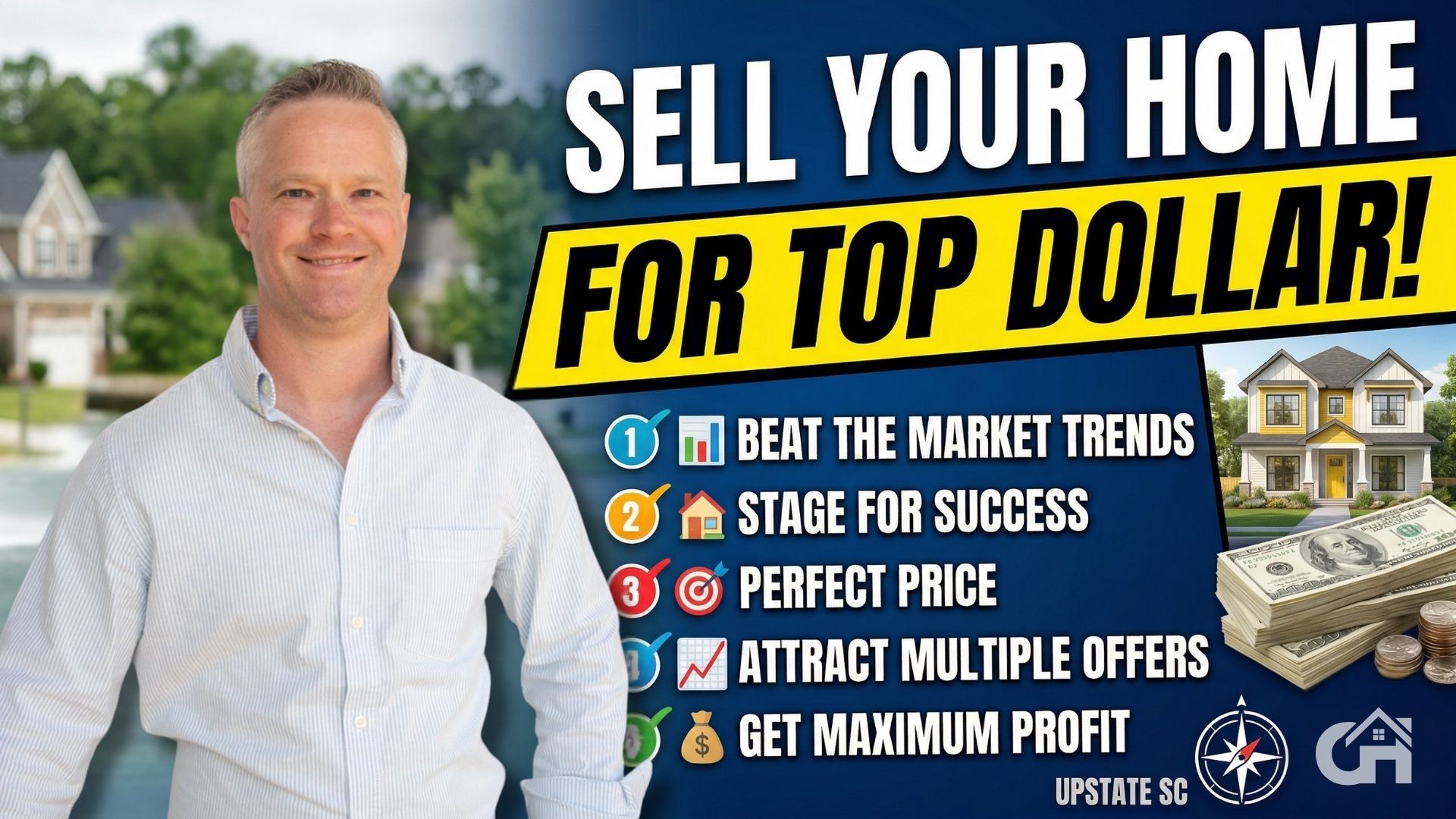
🏡 How to Sell Your Home for Top Dollar Without Leaving Money on the Table
If you want to sell your home for top dollar, the biggest mistake usually happens before the first showing even takes place. Most sellers think top dollar comes from asking the highest price possible, but in reality, it comes from the right strategy, the right preparation, and the right positioning from day one.
Many homeowners leave money on the table without even realizing it. Why? Because they start with emotion instead of the market. They price based on memories, attachment, or what they hope the home is worth, instead of how buyers are actually comparing it to every other option in that price range.
The good news is this: selling for top dollar is not luck. It is a process. When you understand how buyers think, how demand is created, and how strong offers are protected, you put yourself in a much better position to win.
💵 Why do sellers leave money on the table before they even list?
Sellers usually leave money on the table because they start with personal emotion instead of market reality. That one mistake affects pricing, preparation, marketing, buyer interest, and ultimately the final offer.
It is completely understandable to feel attached to your home. You may have raised your family there, hosted holidays there, and invested real time, money, and energy into making it special. However, buyers are not buying your memories. They are comparing your home to every other property they can buy in that same price range.
That is why your strategy has to start with the market. Before you worry about photos, timing, or listing day, you need to understand where your home fits right now. What are buyers paying? What are competing homes offering? How quickly are similar homes selling? What features matter most in your area?
In some markets, buyers care most about walkability and convenience. In others, they care more about privacy, lot size, views, outdoor living, or access to parks, trails, restaurants, and shopping. Top dollar starts when you position your home based on what matters to the buyer, not just what it means to you.
Key takeaway: If you want to sell your home for top dollar, start with the market, not emotion.
✨ How do you make buyers feel like your home is worth the price?
You make buyers feel like your home is worth the price by making it easier for them to picture themselves living there. Buyers shop with their eyes first, and that happens long before they ever walk through the front door.
If you want top dollar, you cannot treat your home only like the place you live. You need to treat it like a product you are preparing to launch. Buyers are scrolling online and deciding in seconds which homes feel clean, bright, inviting, and move-in ready.
That does not always mean a full renovation. In many cases, it means doing the basics extremely well:
- Clean thoroughly
- Simplify each space
- Brighten rooms as much as possible
- Fix small issues
- Remove distractions
- Help each room feel clear and useful
If buyers have to work too hard to imagine themselves in your home, the sale becomes harder. On the other hand, when a home feels easy to understand and easy to picture living in, buyers start assigning more value to it.
Think about it this way. A back patio is not just a back patio. It can become a place for morning coffee or quiet evenings. A bonus room is not just extra square footage. It might be a home office, a workout space, a media room, or a playroom. A home near downtown is not just a location pin. It is convenience, energy, restaurants, coffee shops, and easier daily life.
Key takeaway: Buyers do not just pay for square footage. They pay for how they think life will feel in the space.
📊 How should you price your home to attract strong buyer interest?
You should price your home to attract attention, not chase it. The smartest pricing strategy is the one that creates urgency and momentum early.
One of the biggest mistakes sellers make is saying, “Let’s price high and leave room to negotiate.” It sounds logical, but it often backfires. Top dollar usually comes from momentum, not from sitting on the market.
When buyers see a home that looks great, feels well-positioned, and appears priced appropriately, they move faster. That creates urgency. Urgency creates leverage. Leverage creates stronger offers.
However, when a home is overpriced, buyers tend to hesitate. Instead of saying, “We need to go see that one,” they say, “Let’s wait and see what happens.” That hesitation is costly because it slows the momentum that often leads to the best results.
Top-dollar pricing is not about choosing the highest number possible. It is about choosing the smartest number possible. Yes, lifestyle plays into value. Privacy, outdoor living, convenience, neighborhood access, and a better daily experience can all influence what buyers are willing to pay. Still, the key is pricing based on what buyers will actually respond to, not what sounds good to you as the seller.
When a home feels like a strong value, it often gets the most attention. The home that gets the most attention often gets the strongest offers, and in many cases, multiple offers.
Key takeaway: The right price does not make buyers hesitate. It makes them act.
🔥 How do you turn buyer interest into real demand?
You turn buyer interest into real demand by marketing the home in a way that makes buyers feel something. Simply putting your home in the MLS is not enough anymore.
If you want to sell your home for top dollar, your home needs strong representation and strong exposure. That means strong photos, strong listing copy, video when it makes sense, social media exposure, and clear messaging about why the home stands out.
This is where many sellers miss an important point. Every home has features, but features alone are not what buyers remember. Stories are what buyers remember.
Instead of saying “screened porch,” show buyers a place to relax at the end of the day. Instead of saying “close to downtown,” show buyers the convenience of restaurants, coffee shops, events, and everyday essentials. Instead of saying “large backyard,” show buyers the room to entertain, play, garden, or simply enjoy more breathing room.
That is the difference between listing features and selling lifestyle. And yes, that difference matters. Buyers often decide emotionally first and justify it logically second.
Your marketing should help buyers picture their weekends, their routines, their family dinners, their mornings on the porch, and their evenings in the backyard. The stronger that emotional connection becomes, the more value buyers tend to feel.
Key takeaway: Attention gets you noticed, but emotional connection creates demand.
📄 Why is the highest offer not always the best offer?
The highest offer is not always the best offer because price is only one part of the deal. What matters most is the full offer, not just the biggest number on paper.
A lot of sellers think top dollar means choosing the highest offer and moving on. However, strong negotiation means looking at the whole picture:
- Financing terms
- Inspection contingencies
- Appraisal risk
- Repair expectations
- Closing timeline
- Overall likelihood of reaching the closing table
Paper does not mean much if the deal falls apart or gets chipped away at later. Sometimes a slightly lower offer with cleaner terms is actually the better deal. Sometimes the best buyer is the one who can close on your timeline. Sometimes it is the buyer with fewer contingencies. In other cases, it is the buyer who truly sees the value in your home and is less likely to renegotiate every detail later.
Good negotiation is not just about numbers. It is about understanding leverage, reading motivation, and protecting the value you created through pricing, preparation, and marketing.
Key takeaway: The goal is not just to go under contract. The goal is to get the right contract and protect your bottom line.
✅ What actually helps a home sell for top dollar?
A home sells for top dollar when every part of the strategy works together. It is not just about the house itself. It is about how the home is positioned, presented, priced, marketed, and negotiated.
Here is what that looks like in practice:
- Start with the market
Understand where your home fits and what buyers are responding to right now. - Prepare the home the right way
Clean, simplify, brighten, and make it easier for buyers to picture themselves living there. - Price for attention
Use a pricing strategy that creates urgency instead of hesitation. - Market for emotion
Sell the lifestyle, not just the list of features. - Create a showing experience that confirms the story
Make sure the in-person experience matches the online promise. - Negotiate the full offer
Protect value by evaluating the entire deal, not just the top number.
When these pieces work together, interest turns into demand, demand creates competition, and competition is where top dollar often lives.
🎯 Final thoughts on how to sell your home for top dollar
If you are serious about selling your home for top dollar, remember this: buyers do not just buy homes. They buy comfort, convenience, privacy, connection, and lifestyle.
The better you help them see the life they could live there, the better your outcome is likely to be. That is why the homes that win are rarely the ones that simply hit the market and hope for the best. They are the ones that launch with a clear strategy behind them.
If you are thinking about selling and want to know what your home could realistically sell for, what improvements may actually be worth making, and how to position it to stand out, reach out. I would be happy to help you make a smart move and protect your bottom line.
❓ Frequently Asked Questions
How do I sell my home for top dollar?
To sell your home for top dollar, start with the right pricing strategy, prepare the home well, market it effectively, and negotiate the full offer carefully. Top dollar usually comes from strong positioning and buyer competition, not from simply asking the highest price.
Is overpricing my home a good strategy?
Usually, no. Overpricing often creates hesitation instead of urgency, which can reduce momentum and make your home sit on the market longer. In many cases, the smartest price gets better results than the highest price.
Do I need to renovate everything before listing?
Not necessarily. Most sellers get better results by doing the basics really well, cleaning, simplifying, brightening the home, fixing small issues, and making the space feel easy for buyers to understand.
Why does marketing matter so much when selling a home?
Marketing matters because buyers often form their first impression online. Strong photos, compelling listing copy, and lifestyle-focused messaging help buyers connect emotionally, and that emotional connection can increase perceived value.
Should I always accept the highest offer?
No. The best offer is the one that gives you the strongest overall terms, not just the biggest price. Financing, contingencies, repairs, appraisal risk, and closing timeline all matter when protecting your final outcome.
🔗 Stay Connected With Me
Don’t just read about the Upstate—see it, live it, and explore it with me across social media!
📞 Call/Text me at 864-351-8239
👉 Like & Follow for more: