

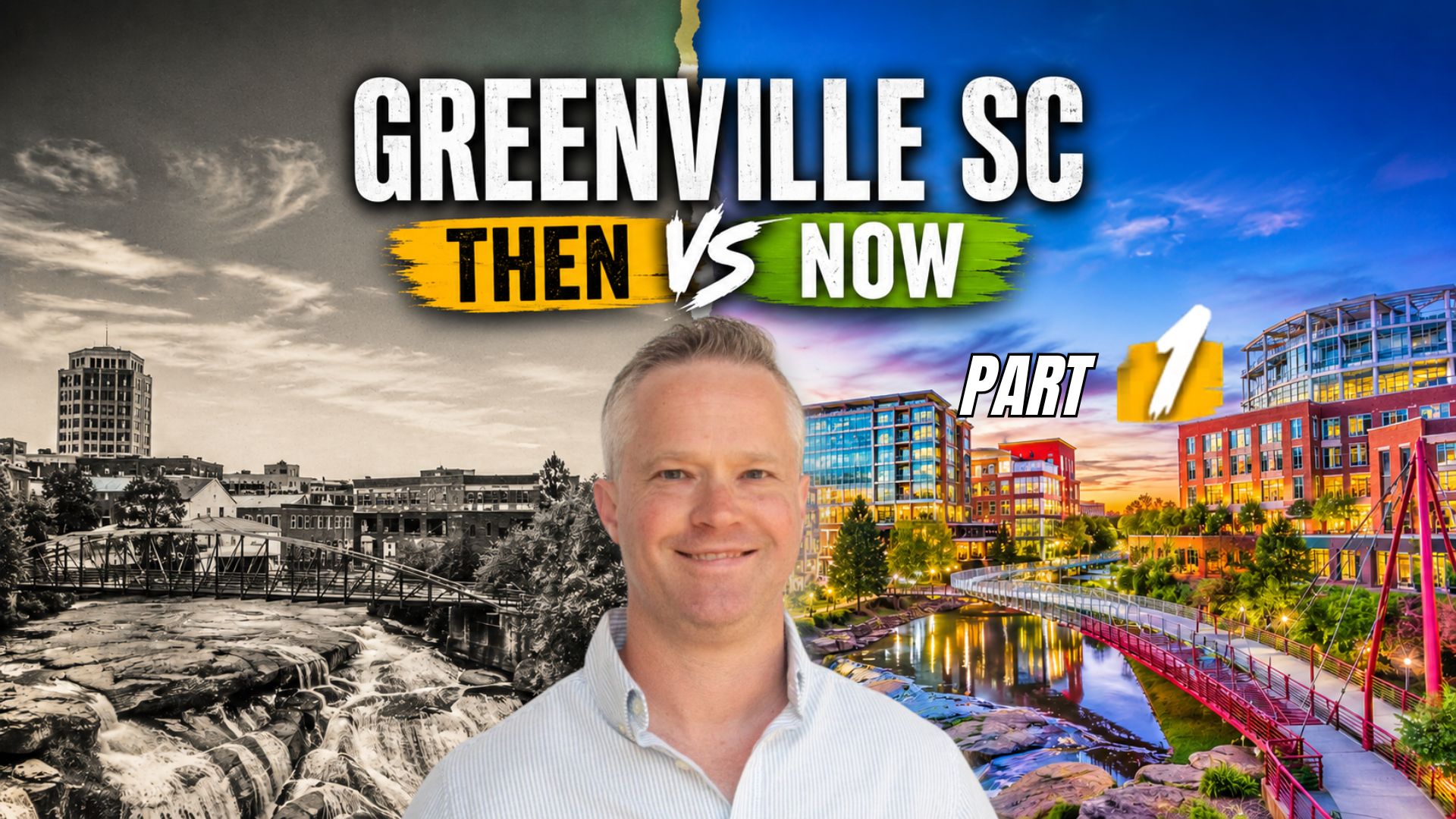
Greenville History Part 1: How Downtown Became the Symbol of Greenville’s Transformation 🌆
The history of Greenville SC did not become famous because of Falls Park alone. Falls Park helped, Main Street helped, and the Liberty Bridge definitely helped, but the real reason Greenville County looks so different in 2026 than it did in 2000 is much bigger than downtown.
It is the jobs. It is the hospitals. It is the schools, the airport, the roads, the new neighborhoods, and the industries that changed how people looked at the entire county. Greenville did not just grow like every other Southern town. It changed directions completely.
And that is what this four-part series is about.
In Part 1, we are starting where most people recognize Greenville first: downtown Greenville, the Reedy River, Falls Park, Main Street, the West End, and Liberty Bridge. Because if you only look at downtown, you miss the whole story. But if you ignore downtown, you miss the symbol that helped Greenville believe it could become something different.
I’m Chris Horrell, your Greenville Realtor with 40-plus years watching this town grow. My team and I help people understand the different lifestyles, neighborhoods, and communities across Greenville County, so they can find the right fit, not just the right house.
What was Greenville County like around 2000? 🕰️
Greenville County around 2000 already had a strong local identity, but it still felt smaller, quieter, and more local than the version people know today. It had manufacturing, hospitals, schools, local businesses, and communities that had been here for generations, but the county had not yet connected all of those pieces into the relocation destination it has become.
According to the U.S. Census Bureau, Greenville County’s population was 379,616 in 2000, and the county’s 2025 estimate reached 583,125. https://www.census.gov/quickfacts/fact/table/greenvillecountysouthcarolina/HEA775224
That kind of growth tells you this story is not just about one park or one pretty bridge. It is about a county that moved from one era into another.
Back then, there were still parts of Greenville County where you could drive for several minutes and feel like you were in between towns. Many of the surrounding communities had not yet become the high-demand suburbs and lifestyle destinations people talk about now. The major commercial and interstate corridors had not yet become the massive residential and retail engines they are today.
Greenville County was standing between two identities. One foot was still in the older textile and industrial South. The other was moving toward advanced manufacturing, healthcare, logistics, lifestyle development, and relocation growth.
Key takeaway: Greenville did not wake up one day and suddenly become popular. The bones were already here. The location was already here. The county simply had not fully connected those pieces yet.
Why did downtown Greenville become the visual proof of change? 👀
Downtown Greenville became the visual proof of change because it gave people a before-and-after image they could understand immediately. Before the growth story spread across the county, downtown became the place where Greenville could show what was possible.
According to the American Planning Association, Main Street in downtown Greenville was once lined with numerous vacant buildings, but long-term planning over about 30 years turned it into a magnet of commerce and social activity. https://www.planning.org/greatplaces/streets/2009/mainstreet.htm
That matters because downtown was not always the polished front door people see today. Around 2000, Main Street had charm, history, and potential, but it had not reached the level of energy, reputation, and lifestyle appeal that defines it now.
Today, people think of downtown Greenville and immediately picture Falls Park, Liberty Bridge, rooftop dining, the West End, outdoor patios, walkable streets, and a Main Street that feels alive. But for years, the falls were partly hidden. The Reedy River was there, but it was not experienced the way it is today.
The natural feature that would eventually become Greenville’s most iconic image had not yet become the centerpiece of the city.
And when Greenville made the decision to reveal that natural feature and turn it into a true public gathering place, it changed more than a view. It changed the story Greenville told about itself.
How did Falls Park and Liberty Bridge change Greenville’s image? 🌉
Falls Park and Liberty Bridge changed Greenville’s image by turning the Reedy River into the city’s most recognizable public space. Before, the river was easy to miss. Now, the river is the place people bring visitors.
According to Greenville.com, Falls Park on the Reedy is a 32-acre urban oasis in the heart of downtown Greenville, and the Liberty Bridge is a 345-foot curved suspension bridge completed in 2004 above the Reedy River Falls. https://www.greenville.com/falls-park-on-the-reedy/
That is the moment when Greenville started telling a very different story about itself.
Before, Main Street was largely a business district. Now, it is a lifestyle. Before, the Reedy River sat in the background. Now, it is the image people post, photograph, and remember. Before, downtown was somewhere people might go for work or an occasional meal. Now, it is one of the first places people visit when they want to understand Greenville.
People did not fall in love with downtown Greenville because of offices. Every city has buildings. People fell in love with the experiences there for the taking.
A dinner downtown. A walk across Liberty Bridge. Saturday Market. A night at Fluor Field. A slow walk through Falls Park after showing family around town.
That is the algorithm Greenville figured out: a city does not become loved because it adds buildings. A city becomes loved when people build their life around it.
Why did downtown Greenville become part of people’s lives? ❤️
Downtown Greenville became part of people’s lives because it turned into a place for habits, memories, and identity. Even people who live miles away from downtown often think of it as part of their Greenville experience.
According to VisitGreenvilleSC, Liberty Bridge at Falls Park on the Reedy has become one of Greenville’s signature attractions, giving visitors a scenic view over the Reedy River and Falls Park. https://www.visitgreenvillesc.com/listing/liberty-bridge-at-falls-park-on-the-reedy/1434/
For locals, downtown became a place to be proud of. For visitors, it became a surprise. For people relocating here, it became the image that made them ask, “Wait, Greenville has what?”
That emotional reaction matters.
When someone visits Greenville for the first time and walks across Liberty Bridge, you can almost hear the shift happen. They thought they were coming to a normal Southern city. Then they see a waterfall in the middle of downtown, restaurants around the corner, people walking everywhere, and a bridge that feels like something you would expect in a much larger city.
Suddenly, Greenville does not feel like a backup option. It feels like a discovery.
This is why downtown matters so much in the relocation conversation. People do not make moving decisions based only on spreadsheets. They make them based on how a place feels. Downtown Greenville gave people a feeling that was easy to understand and hard to forget.
How did Main Street and the West End expand the downtown experience? 🚶♂️
Main Street and the West End expanded the downtown experience by turning one beautiful park into a larger walkable lifestyle district. Greenville did not just create a park. It created an experience around the park.
According to the American Planning Association, downtown Greenville’s Main Street includes wide sidewalks, tree canopy, public spaces, restaurants, mixed-use development, and proximity to Falls Park. The same source notes that Fluor Field’s 2006 relocation helped bring activity into the downtown street environment. https://www.planning.org/greatplaces/streets/2009/mainstreet.htm
That is a major part of the transformation. Falls Park may have been the emotional center, but the West End helped downtown stretch and breathe. Restaurants, historic buildings, Fluor Field, walkable blocks, events, and older buildings with new life all helped create a downtown that felt layered instead of one-dimensional.
And that matters because Greenville did not just need one postcard spot. It needed rhythm.
People needed reasons to come back after they saw the bridge. They needed dinner spots, events, baseball games, coffee shops, date-night options, family walks, offices, apartments, hotels, and public spaces. Slowly, downtown became the kind of place where people built routines.
That is when a place becomes culture.
Key takeaway: Falls Park created the symbol, but Main Street and the West End created the repeatable lifestyle around it.
Where do most Greenville history videos stop too early? 🎥
Most Greenville history videos stop too early when they only show Falls Park, Main Street, Liberty Bridge, restaurants, and drone shots. All of that matters, but downtown is not the whole story.
Downtown was the visible transformation. It was the image people could immediately understand. It was the proof that Greenville could take history, public space, natural beauty, and old buildings and turn them into something people wanted to experience.
But while that was happening in the most visible part of the city, another transformation was happening behind the scenes.
Jobs were shifting. Industry was changing. Healthcare was expanding. Schools were adapting. Research and advanced manufacturing were becoming part of Greenville’s identity. Companies were no longer just passing through the area. They were putting down roots.
This is the bigger point of Part 1. Downtown showed people what Greenville could become, but the deeper countywide engine was already beginning to reshape where people lived, where they worked, what communities grew, and how the entire county would be perceived.
So yes, Falls Park changed the view. Liberty Bridge changed the image. Main Street changed the experience. The West End helped prove that Greenville could turn a downtown into both an identity and a lifestyle.
But what is even more interesting is the deeper change that was happening behind the scenes the entire time.
Why is Part 1 about downtown if the real story is countywide? 🧩
Part 1 is about downtown because downtown became the symbol that made Greenville’s transformation visible. The real story is countywide, but the symbol is downtown.
That is why the Reedy River, Falls Park, Liberty Bridge, Main Street, and the West End matter so much. They helped Greenville believe it could become something different. They gave locals a place to be proud of. They gave visitors a reason to remember the city. And they gave relocating buyers an emotional first impression that often changed how they saw the entire area.
But the waterfall is not the engine.
The waterfall is what people photograph.
The engine is what we are going to talk about in Part 2: jobs, hospitals, schools, roads, the airport, industry, logistics, advanced manufacturing, and the forces that pushed Greenville County into a new era.
If Part 1 is the symbol, Part 2 is the system behind it.
What does downtown Greenville’s history mean if you are moving here now? 🏡
Downtown Greenville’s history matters if you are moving here because it helps explain why the county feels the way it does today. You are not just choosing between homes. You are choosing between lifestyles that grew out of decades of change.
Some people want to be close to downtown energy. Some want the Eastside. Some want Simpsonville, Greer, Travelers Rest, Mauldin, Fountain Inn, Taylors, or more space farther out. Some want walkability. Some want newer construction. Some want historic character. Some want convenience to work, school, airport access, or weekend lifestyle.
Greenville County is not one single thing. That is what makes it interesting, and it is also what makes local guidance so important.
If you only know Falls Park, you do not know Greenville yet. You know the image. You know the symbol. But the right fit depends on understanding how the whole county works.
And that is where a local perspective matters.
Conclusion: Downtown was the symbol, not the whole story 📍
Greenville did not become Greenville because of one bridge, one park, or one street. But downtown gave people the visual proof that something different was happening here.
Falls Park changed the view. Liberty Bridge changed the image. Main Street changed the experience. The West End helped turn downtown into a lifestyle. And together, they gave Greenville the symbol it needed before the bigger countywide transformation became obvious.
So what do you remember about downtown before Falls Park became the image everybody knows? Drop it in the comments, because I would love to hear what Greenville looked like and felt like through your eyes back in the day.
And if you’re trying to figure out where you fit into Greenville’s story today, I’m Chris Horrell, your Greenville Realtor with 40-plus years watching this town grow. My team and I help people understand the different lifestyles, neighborhoods, and communities across Greenville County, so you can find just the right fit, not just the right house.
Make sure you watch Part 2, because that is where we get into the hidden engine behind Greenville’s growth.
Frequently Asked Questions ❓
Did Greenville SC become popular because of Falls Park?
Falls Park helped Greenville become more recognizable, but it was not the only reason the area grew. The park gave downtown a powerful symbol, while jobs, healthcare, schools, roads, airport access, and surrounding communities helped drive broader countywide growth. In other words, Falls Park helped people notice Greenville, but the larger Greenville County engine helped people stay.
Why is Liberty Bridge important to Greenville history?
Liberty Bridge is important because it turned the Reedy River Falls into one of Greenville’s most visible landmarks. Completed in 2004, it created a dramatic pedestrian experience above the falls and gave downtown Greenville an image people could instantly recognize. It also helped make Falls Park feel like the heart of the city’s modern identity.
What was downtown Greenville like before the revitalization?
Downtown Greenville had history, businesses, and local identity, but it did not have the same level of lifestyle energy it has today. Main Street had gone through periods of vacancy and reduced activity before long-term planning, walkability improvements, restaurants, events, Falls Park, and the West End helped bring people back. The change happened over decades, not overnight.
Why does Main Street Greenville feel so different from other downtowns?
Main Street Greenville feels different because it was redesigned around people, not just traffic. Wider sidewalks, trees, restaurants, public spaces, historic buildings, and connections to Falls Park helped create a downtown where people want to walk, linger, eat, gather, and return. That repeat use is what turned Main Street into a lifestyle district.
What is Part 2 of this Greenville history series about?
Part 2 is about the hidden engine behind Greenville County’s growth. That includes jobs, healthcare, schools, infrastructure, GSP airport access, industry, logistics, advanced manufacturing, and the economic changes that helped reshape where people moved and why communities across the county became more in demand.
Final Citation List 📚
- U.S. Census Bureau QuickFacts, Greenville County, South Carolina: https://www.census.gov/quickfacts/fact/table/greenvillecountysouthcarolina/HEA775224
- American Planning Association, Main Street: Greenville, South Carolina: https://www.planning.org/greatplaces/streets/2009/mainstreet.htm
- Greenville.com, Falls Park on the Reedy Visitor Guide: https://www.greenville.com/falls-park-on-the-reedy/
- VisitGreenvilleSC, Liberty Bridge at Falls Park on the Reedy: https://www.visitgreenvillesc.com/listing/liberty-bridge-at-falls-park-on-the-reedy/1434/
- VisitGreenvilleSC, The History of Greenville, SC: https://www.visitgreenvillesc.com/travel-info/about-greenville/history/
🔗 Stay Connected With Me
Don’t just read about the Upstate—see it, live it, and explore it with me across social media!
📞 Call/Text me at 864-351-8239
👉 Like & Follow for more: